
Soft Credit Check vs Hard Check Loans – What’s the Difference?
Soft credit checks are the initial checks you face when you apply by filling in basic form details. It does not impact your credit score. Alternatively, hard credit checks are detailed credit and financial assessments that help creditors understand how much you can afford on a loan. It impacts your credit score temporarily. You can regain it by paying the instalment without a miss.
The blog discusses the difference between soft and hard credit check loans. A soft credit check loan helps you understand the basic amount you may expect to pay, according to the application. So, you may proceed if you can afford the loan according to the approximate costs. Similarly, a hard credit check is when you decide to proceed with the approximate costs.
What is a credit check?
A credit check is an assessment of your income, outstanding debts, CCJs, employment history, residential history and citizenship status. Employers, credit agencies, and loan providers analyse your identity and financial behaviour with these checks.
It states how reliable you are from a financial perspective. You may face one for loans, credit cards, employment, rent, mortgages, car finance, etc.
A credit check is of two types: soft and hard. Soft credit checks are preliminary assessments used for basic loan quotes or pre-qualification. Hard credit checks are detailed assessments that appear on credit reports and affect the credit score.
What is a soft credit check?
A soft credit check is a background review of your credit report that does not affect your credit score. It is commonly used for pre-approvals, employment screening or self-credit monitoring. It may help individuals seeking loans for bad credit in the UK and fetch the most affordable loan without a credit mark.
A soft credit check shows existing credit accounts, bad credit financial links, voting rights, repayment history and public records (CCJs, IVAs or bankruptcy) from the past 6 years. A soft credit check does not get recorded, and no credit provider can see it. You can have multiple soft credit checks on your profile.
What is a hard credit check?
A hard credit check is a detailed view of your credit report that gets recorded. It means any creditor can see the credit inquiries conducted. It affects your credit score temporarily. Your credit score may fall by 5-10 points. It may remain on your credit profile for 12-24 months.
One may face it while getting a mortgage, credit cards, or renting an apartment. Unlike soft credit checks that reveal pre-approval intent, hard credit checks signal active borrowing need and intent.
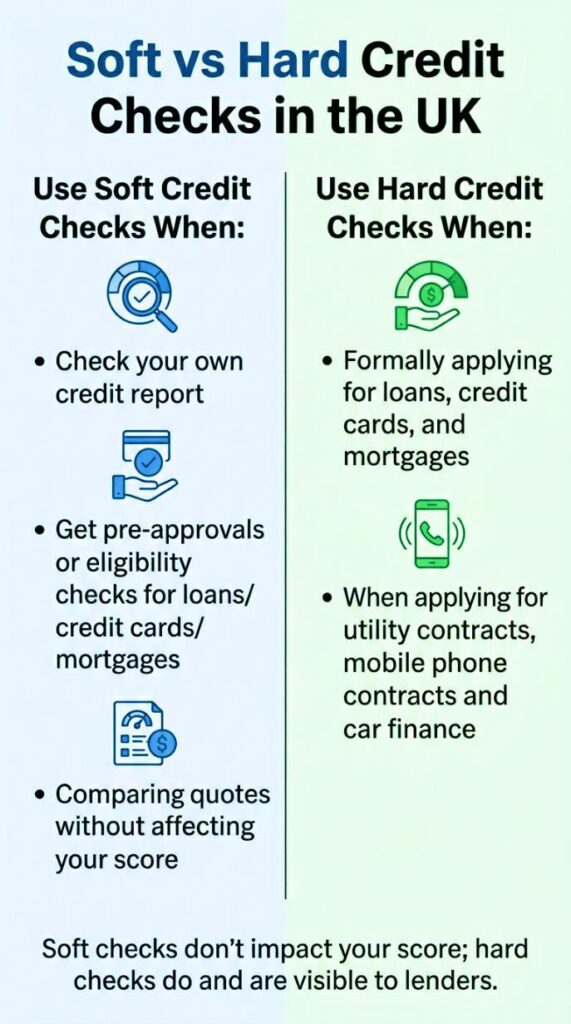
Soft vs Hard Credit Check – What is the key difference?
It is important to know the basic difference between soft and hard credit checks before seeking a mortgage or other loans. Let’s understand:
| Parameters | Soft credit check | Hard Credit check |
| Impact on credit score | A soft credit check does not affect your credit score | It affects your credit score for some time (12-24 months) |
| Consent required | Your permission is not required | Your consent is mandatory for hard credit checks |
| Visibility on credit reports | A soft credit assessment is visible to you and the respective creditor only. | A hard credit check is visible to every creditor for up to 2 years |
| Ideal for | Shopping around for the best interest rates by seeking pre-approvals, quotes and understanding the eligibility for a loan | It is not ideal for shopping quotes. Instead, one should proceed with a hard credit check after confirming the eligibility and affordability. |
Which Loans Use Soft vs Hard Credit Checks?
Soft credit checks help you check eligibility and shop for rates. You can use it for any small loan, like an emergency loan, very bad credit loans, or loans for people on benefits, etc. It does not impact your credit score. You can also use it for preliminary insurance and rent checks.
Similarly, hard credit checks are mandatory if you are seeking car loans, a mortgage, home renovation loans, etc. It grants a complete view of your finances. Accordingly, they calculate the loan amount you can fairly afford to repay.
Can You Get a Loan with Only a Soft Credit Check?
Yes, you can get a loan with a soft credit check. Some short-term loan options, like emergency loans, instant cash loans, etc., do not require a detailed credit assessment. Instead, these are income-based loans that you can get if searching for bad credit loans. However, these loans have high but fixed monthly payments.
What are the pros and cons of hard vs soft credit checks?
Pros and Cons of a hard credit check :
| Pros of a hard credit check | Cons of a hard credit check |
| Helps you get complete approval and personalised rates | It remains on the credit report for 2 years. Thus, it may affect getting better rates, as everyone can see the checks. |
| Provide the loan providers with a complete record of your financial management for easy affordability calculation | You need to provide consent for the detailed assessment. Doing so multiple times hurts your credit score and chances of getting a loan. |
| Unlocks access to instant cash if the loan gets approved | Applying multiple times may hurt future credit approvals and applications. |
Pros and Cons of a soft credit check :
| Pros of soft credit check | Cons of soft credit check |
| You can use a soft credit check facility an unlimited number of times. It does not impact your credit score. | It does not provide a detailed depth into the financial affordability. |
| No one can see the credit checks done on the credit report. | Only reveals the basic eligibility review. |
| Provides the ability to shop for quotes risk-free | It does not provide a detailed insight into approval chances. |
How to Protect Your Credit Score When Applying for Loans?
It is important to protect your credit score while applying for a loan. Otherwise, it may take some time to recover it. Here are some tips that may help you protect your credit score while applying for loans:
1) Understand what loan companies check
Most loan providers check the following details before approving a loan application:
- Payment history
- Electoral registration
- Outstanding debts
- Personal information
- Existing incomings and outgoings
2) Use eligibility checkers (soft credit checks)
Always use eligibility checkers to know whether you qualify. Many loan providers offer the flexibility to check it for free. It does not hurt the credit score. Therefore, you must leverage this opportunity.
3) Avoid applying for credits simultaneously
Ensure a considerable gap in your loan and credit card applications. It may help you avoid hurting your credit score and get better interest rates. It also boosts chances of loan and credit card approvals.
Soft vs Hard Checks for Bad Credit Borrowers
Soft credit checks offer a safe way to test loan eligibility without affecting the credit score. One can compare loan options, interest and costs and fetch the most affordable ones with a zero credit impact. You can do so without committing to any one quote.
Bad credit borrowers should not consider hard credit checks directly. It may hurt the credit score, and the impact will remain on the credit report for 12-24 months. Moreover, if you conduct multiple hard credit checks, then you may stand the risk of loan rejection.
Conclusion
Thus, soft credit and hard credit checks help you understand the right loan and apply accordingly. You may consider a soft credit assessment to know the loan rates or pre-qualify for a loan. Alternatively, hard credit checks are a mandatory assessment that loan and other credit providers conduct to identify affordability. It affects your credit score for some time, while the latter does not.
FAQs
Does a soft credit check show on my credit report?
No, a soft credit check is not visible on the credit report. It helps you know the approximate amount you may qualify for on a loan, but nobody can see it.
How many hard credit checks are too many?
There is no specific number attached to the frequency of hard credit checks. Moreover, the credit score drop depends on the entire credit report, not just the number of hard credit checks.
Can I avoid a hard credit check?
No, you cannot avoid a hard credit check. Especially when applying for loans, credit cards, mortgages, a mobile phone, rent, etc. However, you can use soft credit eligibility checks to understand affordability without affecting a credit score. It limits application frequency and helps you apply for only loans you may qualify for.
Do all loan companies in the UK use hard credit checks?
No, not all companies use hard credit assessments at the initial loan application stage. However, a hard credit check is mandatory if you decide to proceed with the initial loan terms and quote.
Will a hard credit check ruin my credit score?
Yes, a hard credit check impacts your credit score by 5-10%. It remains on your credit profile for 12-24 months.