
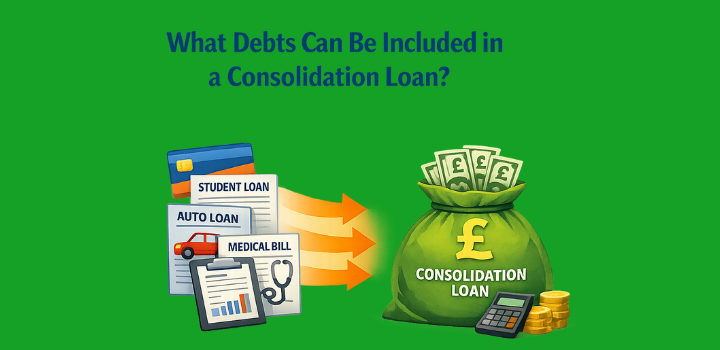
What Debts Can Be Included in a Consolidation Loan?
Different types of debts come with different payment deadlines and different interest rates. Tackling them at the same time can be difficult because of the size of the requirement.
This could be the reason why around 72% of people with multiple debts claim that they face hardship in repaying debts together. Since it also raises the chances of lowering your credit scores, getting a debt consolidation loan for bad credit can be an effective strategy in this situation.
What Types of Debt Can Usually Be Included in a Consolidation Loan?
Most unsecured debts can be combined in a debt consolidation loan. Usually, a lender will allow you to combine payments of debts after ensuring your repayment ability. These are some of the common types of debts.
Credit cards
If you are making the minimum payment every month on the outstanding credit card balance, it accumulates high interest. Through consolidation, you can minimise the burden of interest rates and choose a flexible repayment pattern. Furthermore, the debt repayment process will become faster.
Personal loans
Replacing older loans with a new loan is possible when you combine that with other forms of debt. Here, you will enter into a new loan agreement, including new terms and conditions. The main focus is to try to opt for better rates of interest that can help in lowering the cost.
Store cards
One of the concerns for store cards is high rates of interest, which can even surpass what is being charged for a credit card. They offer benefits while making retail purchases. However, the balance grows super-fast, and consolidation can simplify repayment management.
Overdrafts
Overdrafts can easily accumulate interest rates if not paid off regularly. Authorised overdrafts can be combined and disbursed with a consolidation loan. This way, budgeting can be optimised to make repayment smooth and flexible.
Payday loans
They are known for high interest rates and shorter repayment terms. Consolidating payday loans will help replace expensive short-term debts. You can even enjoy an extended repayment period, which can release the financial pressure you have been enduring so far.
Catalogue debt
This is another form of debt that can also be tackled with a consolidation strategy. You can avoid making multiple payments every month with these accounts, which allow you to complete purchases through instalment payments.
Can Credit Card Debt Be Consolidated into One Loan?
If you have several credit balances to be addressed together, consolidation can work effectively for you. Implementing this step can be beneficial when your cards have accumulated high interest rates. Most importantly, you want to minimise the balances spread across several accounts.
Consolidation becomes necessary when the credit utilisation ratio is negatively impacting your credit scores. Prevent yourself from building new balances on credit cards that have been cleared up through consolidation, as this can intensify your financial difficulties.
Can Personal Loans Be Included in Debt Consolidation?
Yes, unsecured personal loans can easily be consolidated with a new loan. Choosing this strategy makes sense if the ongoing repayment structure is not suitable for you. Experience better budgeting and financial organisation with consolidation.
It would be better for the borrower to compare the before and after interest rates. This is where the whole point is, and if rates are higher than before, consolidation is definitely not the right strategy.
Can Overdrafts and Catalogue Debts Be Consolidated?
These two forms of debt are seen as unsecured borrowing. For this reason, there might not be any difficulty in qualifying for consolidation. Overdraft is often ignored, as they are seen as a convenient option to borrow whenever needed.
However, when they are kept unattended for a long time, interest starts accruing. With catalogue debts, consolidation works wonders when a significant balance is due.
Are There Any Debts That Cannot Usually Be Consolidated?
Yes, not every form of debt is compatible with being consolidated by taking out a new loan. The common ones are:
- Court fines
- Some Government-related debts
- Student loans
- Mortgage arrears
- Child maintenance arrears
- Tax debts in some cases
- Utility arrears with legal action, etc.
You need to check with your individual lender. The lending policies may differ, and you must be aware of the debts that can be consolidated before applying for a specific loan.
Can Secured Debts Be Included in a Debt Consolidation Loan?
This form of debt is more complicated to handle with a consolidation strategy. An asset is attached to secured debts like mortgages, car finance, etc. If you are a homeowner, you can consider getting a secured debt consolidation loan.
This provision will help you treat both secured and unsecured debts. They will be combined into a larger loan that has been secured against a property. It will be helpful in lowering the monthly payments.
However, you should be careful about repaying on time. Otherwise, your assets will be at risk. Traditionally, standard unsecured consolidation loans do not allow for the inclusion of secured debts.
Can You Consolidate Debt If You Have Bad Credit?
Yes, you can consolidate debts despite poor credit. In this case, you will have to look for specific lenders who are ready to accept your low credit scores. The approval conditions will vary from lender to lender.
Your income should be stable, repayments should be affordable, your financial behaviour should have improved, and the ongoing financial pressure should have been minimised. Interest rates might be higher with these loans, but you can compare loan offers to find the most competitive loan options.
Is It Better to Consolidate All Debts or Only Some?
It will completely depend on your individual circumstances. The main purpose behind consolidation is to make debt payments simpler and faster for you.
Depending on your situation, you can choose to treat the expensive debts, as they are contributing largely to increasing your financial burden. You must keep long-term financial impact in mind.
What Should You Consider Before Consolidating Debt?
Before you apply for a loan to consolidate debts, pay attention to these pointers.
- Calculate the total cost of repayment
- Compare the new APR with the existing debt interest rates
- Check if the lender charges additional fees
- Make sure that repayments will be manageable for you
- Avoid accumulating new debts while opting for consolidation
What Alternatives Are There to a Debt Consolidation Loan?
If a debt consolidation loan does not seem suitable, you can explore these options.
- Balance transfer cards
- Debt management plans
- Snowball or avalanche method
- Short-term loans
- Budgeting or financial advice
- Seek financial assistance from family and friends
The bottom line
Before considering consolidation, you must understand the types of debts you can include and qualify for. Besides, pay attention to aspects for a smooth repayment experience later.
FAQs
Can I consolidate government debt in the UK?
Some Government-related debts may qualify for typical debt consolidation loans. However, some debts will remain excluded. You must discuss with your lender to get clarity on this.
How many debts can be included in one loan?
No fixed limit is there. You can merge several debts, like credit cards, loans, overdrafts, etc. The only thing is that the borrowing amount should remain affordable for you.
Do I need to own a home to get a consolidation loan?
If the amount involved in consolidating debts is larger, you might be required to pledge an asset. Otherwise, you can borrow unsecured funds to treat debt issues.